Before the trade · The evidenceMindset
What Trading Psychology Actually Means
One phrase is doing the work of four separate subjects. Three of them have been measured. The fourth is the one most of the writing is about.

Key takeaways
- "Trading psychology" is used for at least four separate subjects, and they have very different amounts of evidence behind them.
- What has actually been measured is behaviour and its cost: how often people trade, what they sell, what they hold, and what that pattern does to returns.
- Emotional intensity has been measured in traders too, and it was associated with worse results — but the study could not say which decision to change.
- The part of the field with no evidence at all is the part that is written most confidently: the list of five emotions, repeated without a source.
- Nothing on this page is advice, and no number here applies to you. Each one describes a named population over named years.
In this article · 6 sections
The short answer
"Trading psychology" is a phrase, not a subject. It is used for at least four different things: the emotional states a person is in while trading, the decision patterns that have been documented in real account data, the beliefs people hold about their own accuracy, and a genre of advice that has no research behind it at all.
The first three have been studied, and this page is mostly about what those studies found. The fourth is the one you have almost certainly read: the list of five emotions, the assertion that ninety per cent of traders fail, the claim that discipline is the only thing standing between you and consistency. That material is not wrong so much as untestable. It asserts, and the assertions are rarely attached to anything you could check.
The useful question is not "how do I master my psychology?" It is narrower and more answerable: which decisions have been shown to cost people money, and are they decisions I can write down in advance?
The four things the phrase is covering
First: emotional states during trading
This has been measured directly. Lo, Repin and Steenbarger recruited eighty volunteers from a five-week online training programme for day traders and asked them to complete daily emotional-state surveys alongside a standard personality inventory, then compared those measures with each participant's daily profit-and-loss record.
Two findings matter. Participants whose emotional reaction to monetary gains and losses was more intense — on the positive side as well as the negative — showed significantly worse trading performance. And the personality inventory revealed no specific "trader personality profile" at all, which the authors took as raising the possibility that trading skill is not innate and that different personality types might perform trading functions equally well after instruction and practice.
That second result is worth sitting with, because it contradicts an entire genre of writing about the trader temperament. It is also a small study, and the authors are careful about what it can bear: when they compared the best and worst performing thirds of their sample directly, they noted that the differences were not large enough to make the conclusion conclusive on their own.
Second: documented decision patterns
This is the strongest body of evidence in the field, and it does not come from surveys. It comes from account records.
Barber and Odean examined 66,465 households with accounts at a large American discount broker between 1991 and 1996. The average household turned over more than 75 per cent of its common stock portfolio a year and earned an annual return of 16.4 per cent against a market return of 17.9 per cent. Split by how much they traded, the gap widens sharply: the households that traded most earned 11.4 per cent a year, while those that traded least earned 18.5 per cent.
That is the shape of the finding that most of this publication's risk and process articles return to. The expensive thing was not being wrong about direction. It was the frequency of the decision itself. We look at why that happens, and what it costs, in the article on trading too often.
Third: beliefs about your own accuracy
Research separates at least three distinct things that get called confidence: thinking you performed better than you did, thinking you performed better than other people, and being too certain that your estimate is close to right. In the experimental work, these three measures were close to uncorrelated with one another, and no personality measure predicted them once the number of comparisons was properly accounted for.
This is not a semantic quibble. It means "am I overconfident?" is not one question with one answer, and that your own sense of the answer is poor evidence either way. We take that apart in the piece on judging your own confidence.
Fourth: the advice genre
The fourth category is the one with no evidence behind it, and it is the one most of the word count in this field goes to. Its characteristic move is a confident number with no document behind it: a survival rate, a failure percentage, a claim about what separates winners from losers. We traced the most famous of those numbers back as far as they go in our piece on the figures the industry repeats. Some of them lead to a regulator's study. Some of them lead nowhere.
What the evidence is actually about
Read the studies rather than the summaries of them and a pattern appears that is quite different from the one the advice genre describes.
It is about frequency, not emotion. The Barber and Odean result is a turnover result. The Taiwanese market data tells the same story at national scale: across every investor in Taiwan between 1995 and 1999, the aggregate portfolio of individuals carried an annual performance penalty of 3.8 percentage points, an amount the authors put at 2.2 per cent of Taiwan's gross domestic product. Over the same period, day trading accounted for 23 per cent of the total value traded.
It is about costs that are charged per decision. Spread, commission and — in the Taiwanese case — transaction taxes are paid every time, whatever the position does afterwards. Double the number of trades and you double those. You do not double the quality of the reasoning.
It is about what you do with a loss, not how you feel about one. The most interesting recent result here is Imas's: following a loss that has been realised, people took less risk; where the same loss was left open on the screen, they took more. The difference was not the size of the loss or the mood it produced. It was whether it had been booked. That is the subject of what happens in the hour after a loss.
It is about decisions you can make before anything is at stake. The psychology literature on plans is unusually clear on this: a goal is a weak predictor of behaviour, and a specific if-then commitment is a much stronger one. We set out what that implies for the things a plan has to settle in advance.
What the evidence is not about
It is worth being equally explicit about the limits, because this is where the field tends to oversell.
- None of these studies is about you. Each describes a named population over named years: American discount-brokerage households in the early 1990s, Taiwanese investors in the late 1990s, Brazilian futures traders between 2013 and 2015, eighty volunteers on one training course. An average over a population is not a prediction about an individual.
- Almost none of it is about leveraged retail products. The regulators have data on those, and we use it where it applies, but the academic record is mostly equities.
- Nothing in it establishes that any particular habit will make you profitable. The findings are about costs and patterns, which is a different and more modest claim.
- Survivorship runs through all of it. Studies of people who kept trading are studies of the ones who did not stop.
How to use this
If you want a practical reading order rather than a theory, it is this. Start with what the numbers in this field actually say, because a lot of what follows is a reaction to numbers that were never checked. Then look at frequency, because that is where the measured cost is. Then at the two decisions that are made under the most pressure — how much a mistake is allowed to cost, and what you do when a position goes against you. Then at the records that let you answer any of this about yourself rather than about a population.
That last step is not optional, and it is the reason we keep coming back to keeping a usable record. Every study cited on this page works from data that was collected before anyone knew how the trade turned out. Without that, a review of your own trading is a review of your explanations.
Where this publication stands
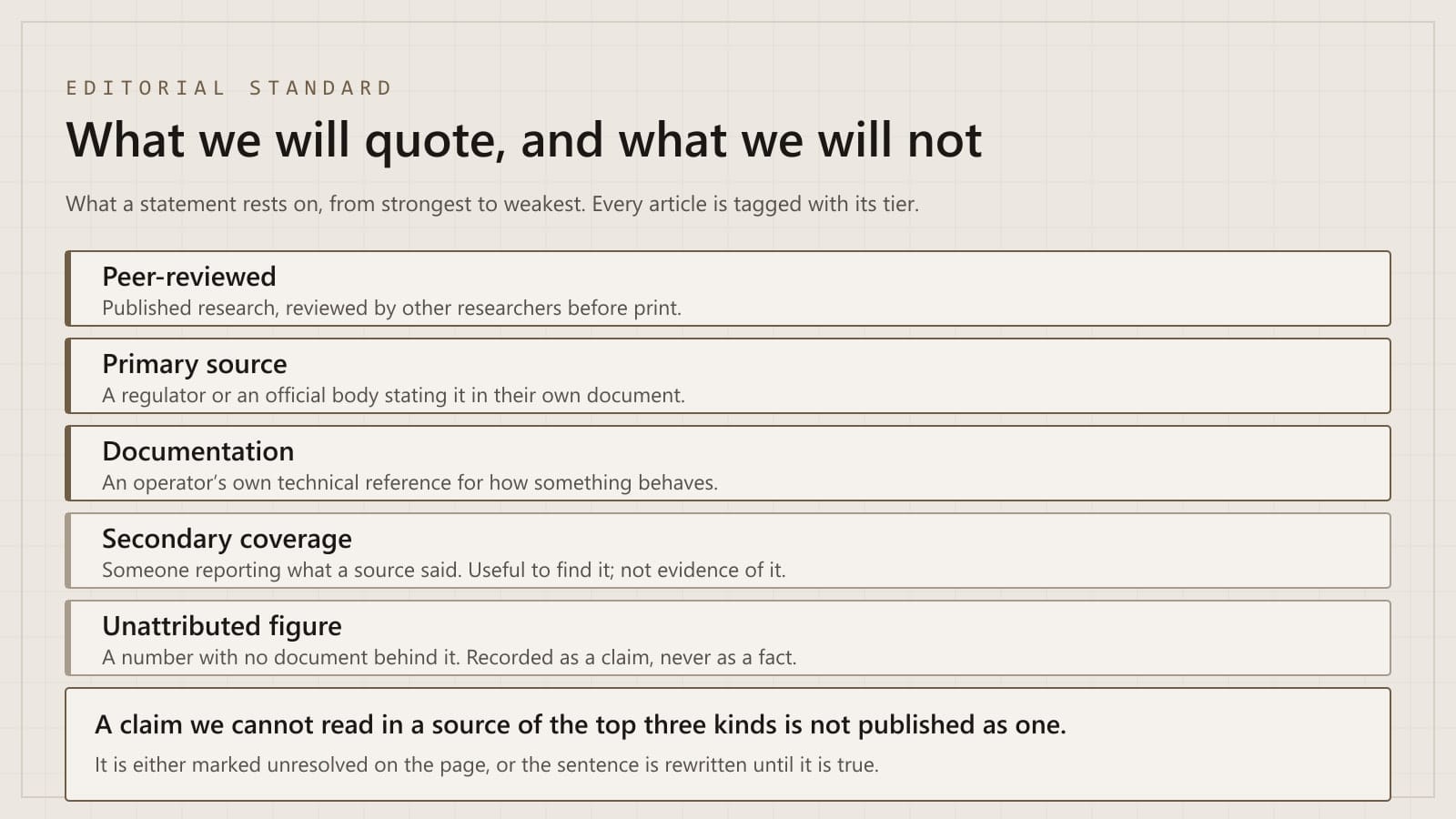
We are not a broker, a signal service or a trading course, and we do not sell anything on these pages. That is the only reason this article can say that the most widely repeated statistic in the field does not have the source it is usually given — a sentence that would cost most sites in this market their best marketing line.
Where we cite a figure, we have read it in the document it came from, and the document is listed at the foot of the page. Where we could not, we say the number is unsourced and leave it out. There is a fuller statement of that rule on the evidence pages, and it is the standard every article here is held to.
Nothing on this site is investment advice or a recommendation. Trading leveraged products carries a high risk of losing money quickly, and the regulators' own figures on how often that happens are set out in the articles linked above.
Sources and references
- Trading Is Hazardous to Your Wealth: The Common Stock Investment Performance of Individual Investors — The Journal of Finance (authors' copy, Haas School of Business, UC Berkeley)Peer-reviewed study · retrieved 6 October 2026
- Just How Much Do Individual Investors Lose by Trading? — The Review of Financial Studies (authors' copy, Haas School of Business, UC Berkeley)Peer-reviewed study · retrieved 6 October 2026
- Fear and Greed in Financial Markets: A Clinical Study of Day-Traders — National Bureau of Economic Research (working paper 11243)Peer-reviewed study · retrieved 6 October 2026
- The Realization Effect: Risk-Taking after Realized versus Paper Losses — American Economic ReviewPeer-reviewed study · retrieved 6 October 2026
- The Three Faces of Overconfidence in Organizations — Social Psychology and Organizations, Routledge (author's copy)Peer-reviewed study · retrieved 6 October 2026